You Can't Judge an Infant
Why judging a founder and their new idea is just as hard as judging an infant

From seeing a handful of startups go from zero to something now, I’ve learned that it is very hard to predict if they will work out or not.
Nothing new in that, but I think I’ve finally stumbled on an analogy that helps explain why that is, and I’m starting to believe that it’s the same underlying principle that makes it practically impossible to judge an infant’s chances of achieving something in their lives.
You simply have no clue what a 6-month old infant can grow up to do — whether that’s writing novels or building rockets — and I think the same is true for ideas in their infancy.
Just imagine
Trust me, there is a point here but play along for a second.
Imagine you’re walking down the street in your neighborhood on your way home from work. You spot two neighbors down the road chatting, and as you are approaching them, you begin to hear what they’re saying.
One of them has their newborn in a baby carriage, and you hear the other person say to the parent:
I mean, there’s no way this little person is going to write novels. Look at it. It can’t even hold a pencil. It can’t even speak! How would it ever write novels?
What? That’s a weird thing to say. That person must be retarded. Of course, they can’t plausibly evaluate an infant’s chances of writing novels based on its current abilities. They have no clue what that child will grow up to find a passion for and be able to.
Yet, that type of logical reasoning is pretty much exactly how we tend to judge new ideas and their founders.
Coinbase in 2012
When Coinbase IPO’d with an $85b valuation a few weeks ago, Twitter exploded with investors sharing their dismissal emails to the founder Brian Armstrong.
The tweet that really stuck with me though was Austin Allred’s tweet about the skeptical comments to Armstrong’s Hacker News post looking for a cofounder in 2012:
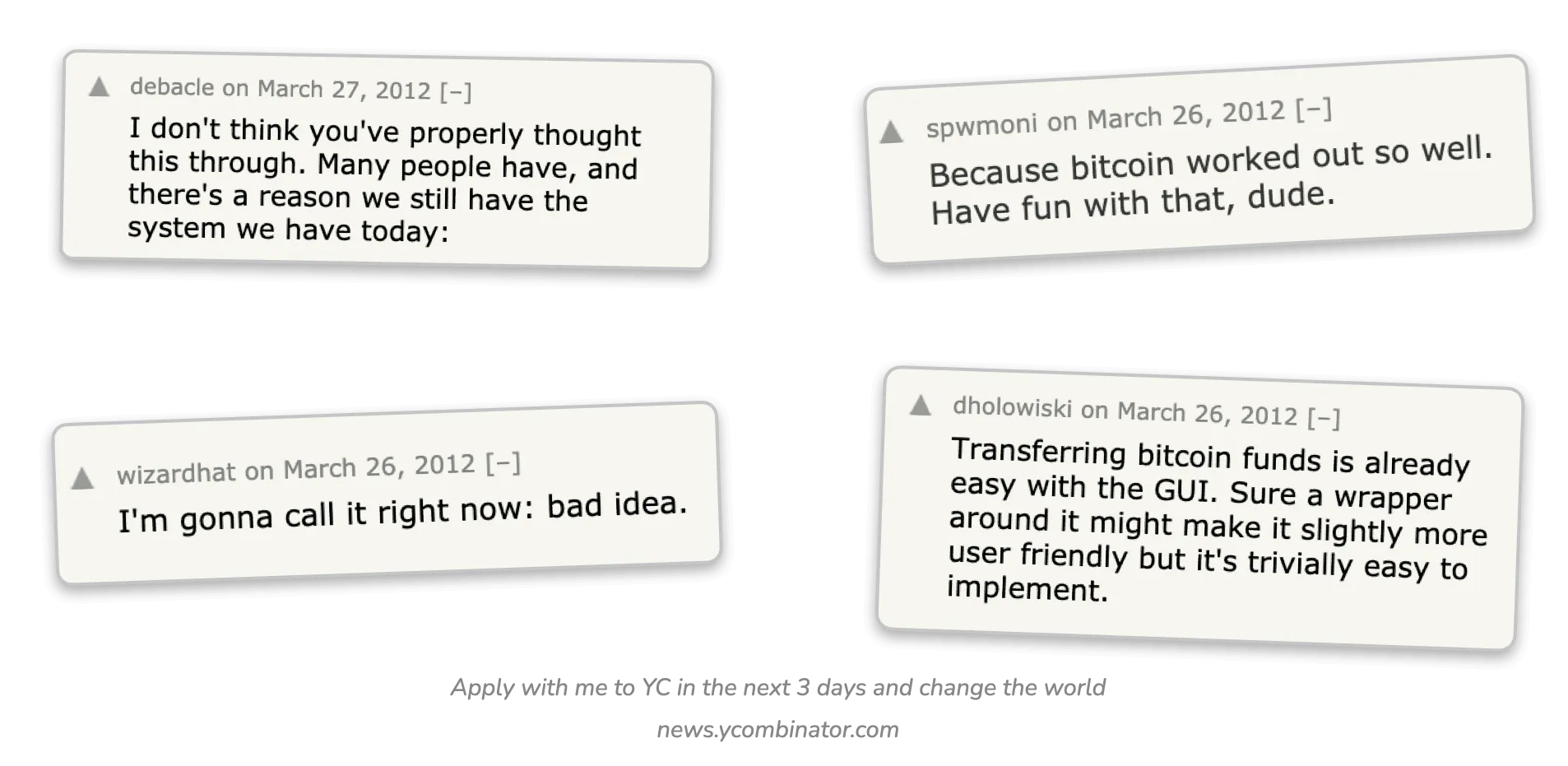
Then a week ago, Suhail Doshi launched Mighty on Hacker News, a new browser, and pretty much the same pessimistic criticism played out:
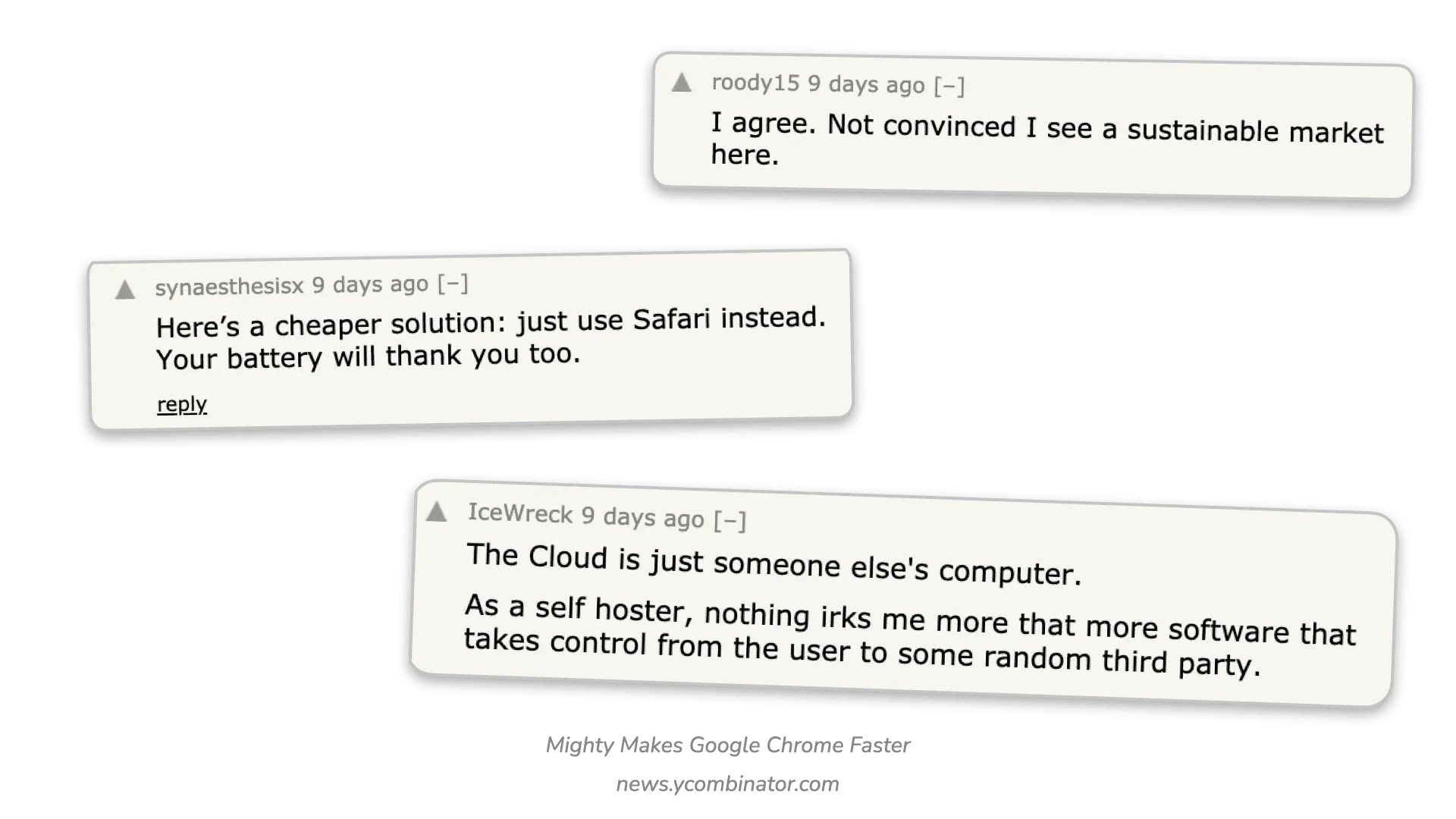
These comment sections offer such insights into this phenomenon.
Especially when a guy like Doshi, the founder of Mixpanel, who has a pretty well-established track record of building software for the browser, gets torn apart like this.
I mean, the points here are fairly legit, but if the goal here were to learn, help, or explore why this seemingly clever guy would build something like this, the wording and tone would be completely different.
Interestingly, Paul Graham just published an essay about this phenomenon exploring the reasons why people aggressively dismiss these types of ‘Crazy New Ideas’:
The wise response to such an idea is not to make statements, but to ask questions, because there’s a real mystery here. Why has this smart and reasonable person proposed an idea that seems so wrong? Are they mistaken, or are you? One of you has to be. If you’re the one who’s mistaken, that would be good to know, because it means there’s a hole in your model of the world. But even if they’re mistaken, it should be interesting to learn why. A trap that an expert falls into is one you have to worry about too.
This all seems pretty obvious. And yet there are clearly a lot of people who don’t share my fear of dismissing new ideas. Why do they do it? Why risk looking like a jerk now and a fool later, instead of just reserving judgement?
History tells the same story
The above phenomenon is nothing new though. Looking back through the industrial revolution, humans have always done this.
Check out these laughable quotes from the invention of telecommunication, the lightbulb, and the early days of computers that I pulled out of Engines That Move Markets.
What use could this company make of an electrical toy?
— 1876, William Orten, President of Western Union, turning down the offer of Bell’s patents for $100,000.[Edison’s ideas are] good enough for our Transatlantic friends… but unworthy of the attention of practical or scientific men.
— 1878, British Parliament Committee.Everything that can be invented already has been invented
— 1899, Charles H. Duell, Director of the U.S Patent Patent Office.I think there’s a world market for maybe five computers.
— 1943, Thomas Watson, chairman of IBM.
To ask the same things as Paul Graham: Why risk looking like a jerk now and a fool later, instead of just reserving judgment?
Jante Law
This critically pessimistic tendency for new ideas is something I’ve found very prevalent in the UK and Denmark. The majority of people will just rather talk about why things won’t work rather than why they might.
Sadly. But why?
Graham goes on to reason about that, saying:
One reason they do it is envy. If you propose a radical new idea and it succeeds, your reputation (and perhaps also your wealth) will increase proportionally. Some people would be envious if that happened, and this potential envy propagates back into a conviction that you must be wrong.
Another reason people dismiss new ideas is that it’s an easy way to seem sophisticated. When a new idea first emerges, it usually seems pretty feeble. It’s a mere hatchling. Received wisdom is a full-grown eagle by comparison. So it’s easy to launch a devastating attack on a new idea, and anyone who does will seem clever to those who don’t understand this asymmetry.
I really hate this, especially because that we, in Denmark, have even named and accepted this cultural marker as Jante Law, according to which:
… not conforming, doing things out of the ordinary, or being personally ambitious [is] unworthy and inappropriate.
Screw that!
Be critical, yes, but optimistic. Be curious, ask why, ask how, but add value.
We need people to do things out of the ordinary, and since you can’t judge an infant anyway, why not default to optimism?