The Request Access Launch
Subjects: Superhuman, Mighty, and Coda

It’s been hard to not notice Superhuman on Twitter over the past few months. They’ve managed to generate remarkable word of mouth about their, supposedly, “fastest email experience ever made”.
Frankly, I’m dying to get off the waiting list and try it too. Yes, there’s a waiting list to pay them $30/month for their app. And they claim there are 200k people on it.
Superhuman’s exclusive access, pre-access filtering, and handheld onboarding are counterintuitive methods for scalable web-based software, but it seems to really work, and I’ve started noticing other saas elites pulling the same tricks.
Mighty, founded by Suhail of Mixpanel, is also in a closed beta with a request access CTA on their site followed by a Typeform questionnaire — that’s prior to launching the product though.
Similarly, Coda, with co-founders from Youtube and Microsoft and $60m backings, also used a request access CTA on their landing page for their month-long beta. The interesting part here is that they continued to do so long after they opened access to anyone with an email.
Because of laziness? I doubt it.
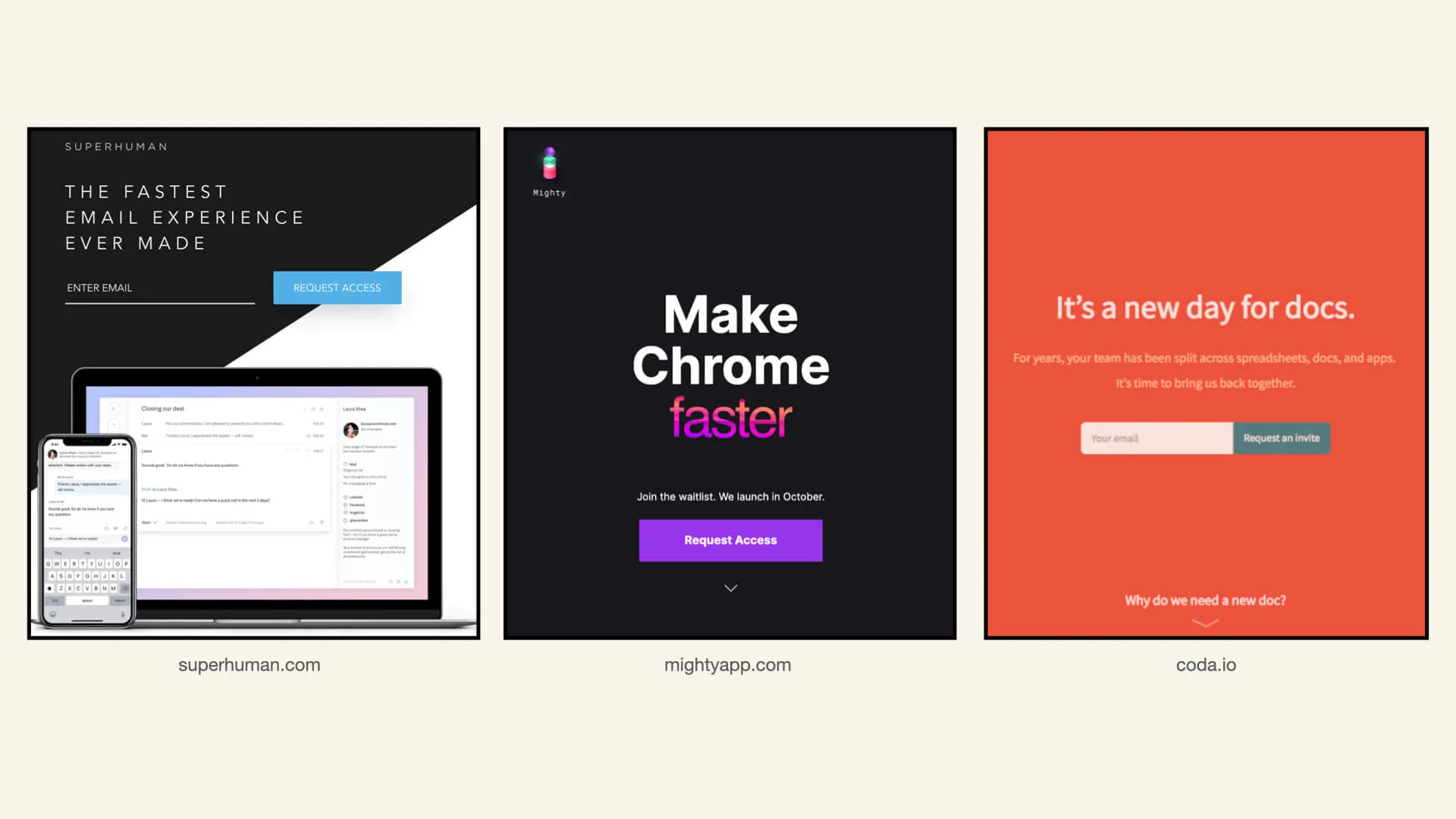
The acquisition and activation tactics used by these startups aren’t obvious, so they seem worth analyzing, and that’s what I’ll attempt to do here as a learn more about them.
I’m initially curious if exclusive access generates more demand? Whether being in beta generates more user feedback, bug acceptance, and insights? And what tools these elite startups use to learn from their users in the process.
Mighty, Superhuman, and Coda are good candidates for this analysis with backing from top-tier VCs, like Greylock and a16z, and founders of high caliber.
So, let’s dive in.
Request Access CTA
They all have the CTA request access. You can’t just simply sign up to Superhuman. You can skip the queue with a referral, but otherwise have to request access.
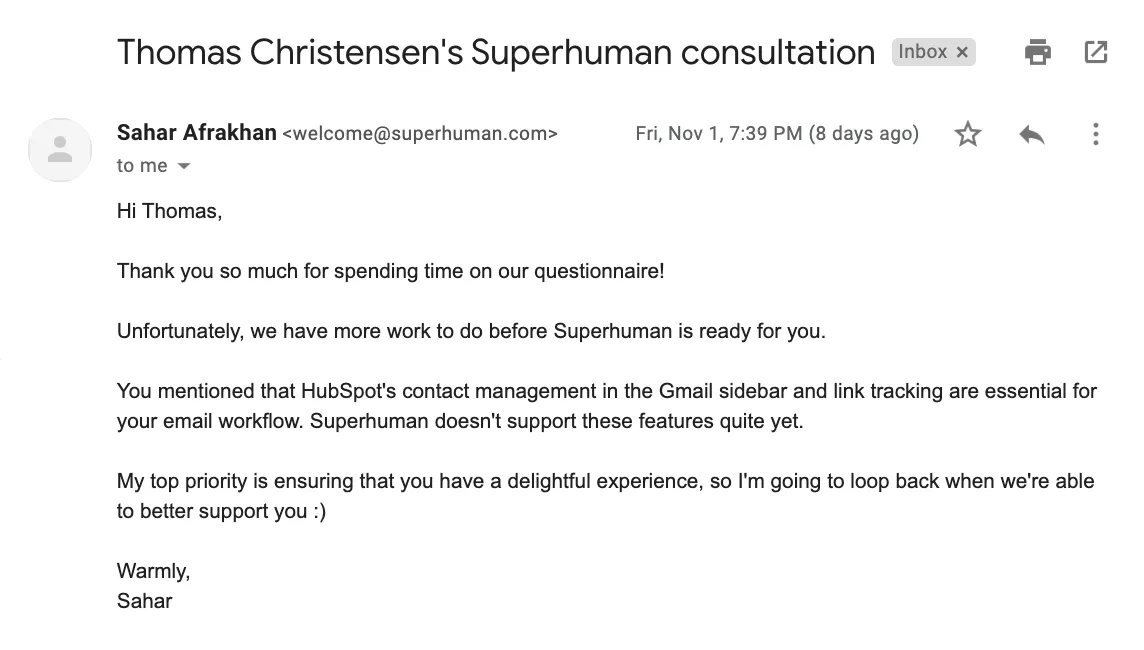
So, I did that last week and got this email:
I then filled out a 25-step Typeform and after 5 minutes, received this email:
Now, it’s clearly an automated process but I’m impressed with the contextual relevance and delivery. Notice:
You mentioned that HubSpot’s contact management in the Gmail sidebar and link tracking are essential for your email workflow. Superhuman doesn’t support these features quite yet.
My top priority is ensuring that you have a delightful experience, so I’m going to loop back when we’re able to better support you :)
At a glance, it might actually seem to be crafted by hand, and with warm regards from Sahar. I could have asked for 20 different features, but his reply was relevant to those I did ask for.
Well done. So how did they automate that process?
The $30 Segmentation Stack
Well, from the survey, we know they use Typeform, and as expected, Typeform has a webhooks API and native integrations that enable Superhuman to receive the data from my response and based on that response, compose a relevant email and send it to me. Probably using Zapier and Gmail. Or Superhuman?
SaaS companies like Notion, Airtable, and Coda do this segmentation too, but they’ve built their own forms into the onboarding process and tend to ask 3-5 questions. Superhuman and Mighty gathers 20 data-points on you using off-the-shelf tools, and that’s prior to you even accessing the product. Superhuman might even deny you access!
Interesting. Let’s break down what’s involved:
- A landing page with a Request Access call to action.
- A Typeform questionnaire.
- An email service, like Sendgrid or Gmail with some Zapier magic.
- Some CRM to log this data against the user ID for future reference. Hubspot or Salesforce, or simply Airtable or a Google Sheet.
Pretty simple.
The model doesn’t even require a working product and can be applied to almost any software tool. It’s $30/mo for Typeform, but with a bit of creative spirit, it’s a lean way to launch fast and start engaging your users and the market before you built something neither wants.
The noteworthy part though seems the filtering of the audience into segments that qualify for access.
We can question whether isolating engagement metrics and resource allocation in batches is truly effective, but I’m mostly interested in the ability to deploy a certain feature set or product, against a certain market, in controlled batches.
It’s certainly easier to hyper-focus on specific targets with all energy if you control what comes through the gates, but do you not risk isolating yourself from discoveries in other segments and not finding the fit?
Hmm… I don’t know. It’s an interesting question. What I do know, is that it’s annoying that I didn’t qualify for access, but I’m only more drawn to the product now.
I’m impressed.
The Questionaire
The questions they use to filter us would be interesting to break down.
Superhumans are dynamically changing based on your answers, so yours might be slightly different, but here are the ones I got:
- What is your full name?
- Where do you work?
- And what is your role there?
- What is your work email address?
- What devices do you use for work email?
- What type of computer do you use the most?
- What do you use for work email the most on your computer?
- Do you currently use any of these plugins or extensions while you email?
- Which [plugins selected] features are essential to your email workflow, if any?
- Which mobile device do you use for work email?
- What do you use for work email the most on your mobile device?
- Do you have an iPad?
- Do you use your iPad for work email?
- Do you use a keyboard with your iPad?
- What do you usually do with emails that do require further action?
- What do you usually do with emails that do not require further action?
- Which of these features do you currently use while emailing?
- How much of your working day is spent doing email?
- How many emails do you send per day?
- How satisfied are you with your current email solution?
- What are your email pet peeves?
- Finally, what excites you about Superhuman?
22 questions. 22 data points. Pre-access!
Handheld onboarding
I still don’t have access — which sucks — but, Rahul promised me white-glove service so I bet it’ll be interesting.
Here’s a primer from a TechCrunch article where Lucas Matney writes about his experience with the gloves:
Other founders I’ve chatted with have been inspired by how Superhuman’s on-boarding process helps users feel like they’re getting a product custom-built for them. I met with Vohra during my 30-minute meeting where he walked me through the product and asked me about my own email habits as he helped me set up my account. The result is a bizarre connection with the product and team.
For example: for 30 days after you set up your account, you get an email from Vohra detailing some tips and tricks for using the service. Not only did I not immediately unsubscribe from these messages, I read almost all of them. When I filled out a survey at the end surrounding what I thought about the service, an employee at the startup shot me an email a few days later with a full response, I responded to that.
[…] I almost felt like I had to apologize to the startup for cancelling my subscription. I felt so coddled as a member of the service with every new little update feeling like a new membership perk.
How interesting is that? More to come when I get access.